


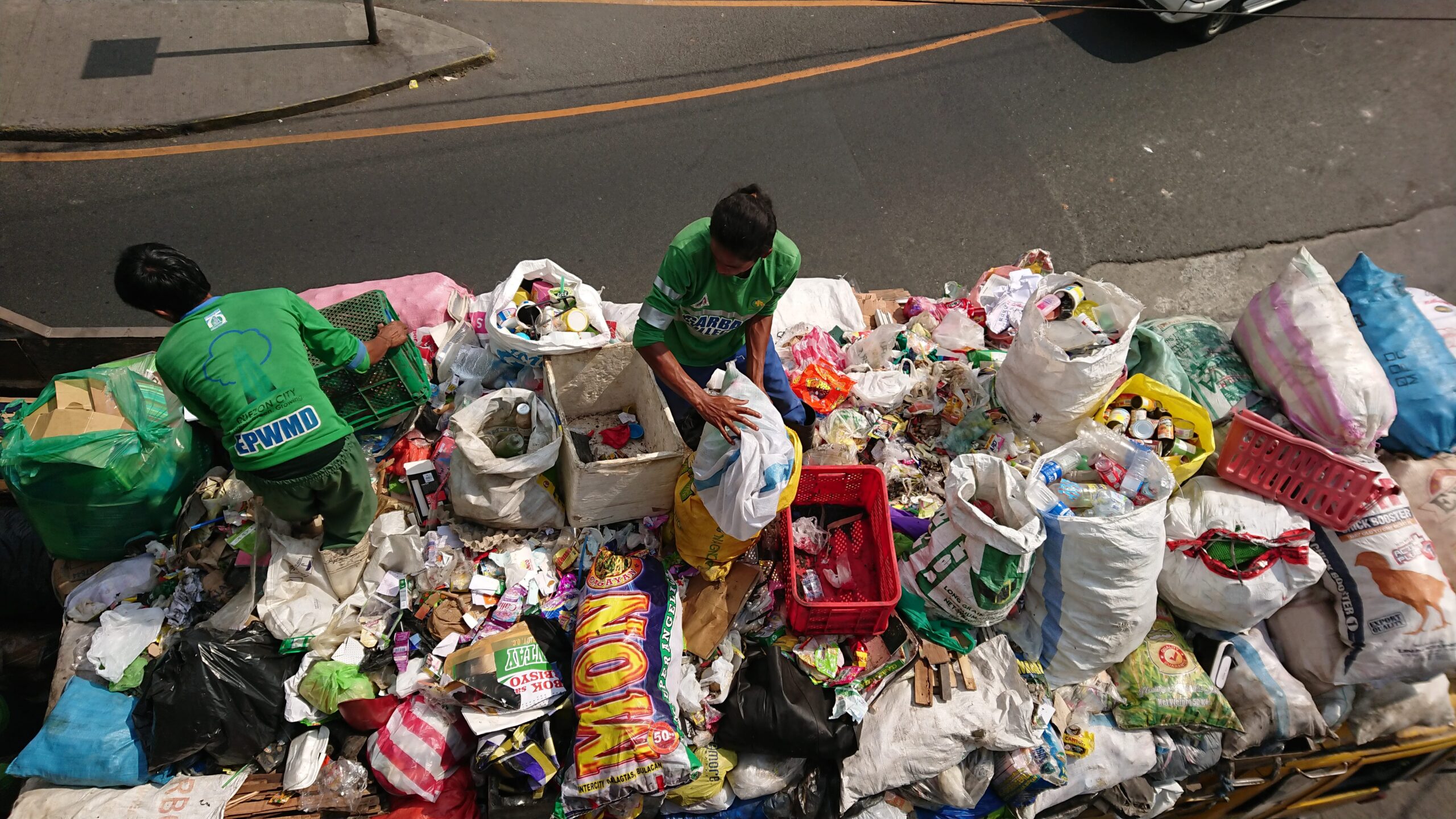
© Mirjam Overhoff, alle Rechte vorbehalten
Global waste, local consequences: The plastic waste crisis in Southeast Asia
The immense global amount of plastic continues to rise due to consumption. Only a small portion of it is recycled. It has long been known that plastic does not decompose but breaks down into tiny particles. Microplastics can now be found everywhere: on glaciers, in oceans, in soil, in animals and plants, and therefore also in us humans.
Up to 150 million tons of plastic are currently floating in the world’s oceans. Around 19 million tons are added every year – and the trend is rising. Single-use plastic is the main component of marine pollution. In Southeast Asia, a lot of plastic waste enters the oceans via rivers such as the Pasig in the Philippines, the Mekong in Vietnam, Cambodia, Laos, Thailand, and Myanmar, and the Citarum in Indonesia. But extreme weather events such as typhoons, storms, floods, and landslides also transport plastic into the natural environment.
However, the flood of plastic is not only caused where its consequences are most obvious. Large amounts of plastic waste produced in Europe are exported to Southeast Asia. Indonesia, Vietnam, Thailand, and Malaysia take in most of Europe’s waste – and live with the consequences. The headquarters of the biggest producers of single-use plastic: Nestlé, Coca-Cola, Unilever, and Procter & Gamble are all located in Europe and North America.
A critical examination of the structural causes of the plastic crisis and the actors involved is essential to develop solutions that are socially justice and contribute to the reduction and prevention of plastic in the long term. More and more consumers are aware that their individual approach to waste plays an important role. However, responsibility cannot be shifted onto individuals alone. Social and political approaches as well as community initiatives are also necessary to enable structural changes and effectively limit the production and consumption of plastic. To initiate such changes, public and political pressure is also needed to support and drive forward ambitious measures.
Against this backdrop, this issue of südostasien focuses on the effects of the plastic crisis and how society deals with waste. The focus is on the diverse actors along the entire value and disposal chain: from production and sales to consumption, disposal, recycling, and reuse of plastic. Our goal is to highlight the complex interactions between these sectors in order understand the structural relationships better.
Possible questions for articles could include:
- How have social awareness and public debate on the use of plastic/plastic waste in Southeast Asia changed in recent years?
- Which global waste/plastic regulations are having an impact in Southeast Asia?
- Who produces and distributes the most plastic in Southeast Asia?
- Where and how are countries and corporations in the Global North taking responsibility for single-use plastics? Are there any relevant projects in the field of development cooperation?
- Are there any initiatives by critical consumers in the Global North in solidarity and cooperation with actors in Southeast Asia?
- How are political and legal institutions in Southeast Asia creating framework conditions to encourage industry and consumers to behave sustainably?
- Which actors influence plastic and waste policy (from the local to the international level)?
- What is the role of colonial, postcolonial, and neocolonial structures in this context?
- How does informal and formal waste disposal work in Southeast Asia? What is everyday life like for waste collectors, pawnshop employees, refuse collectors, etc.?
- How are the different types of waste recycled? What are the problems with recycling waste?
- What opportunities and projects exist in the circular economy?
- How is waste prevention and/or recycling practiced? How noticeable are these alternatives? What social/commercial/political resistance exists to this?
- What community-based alternatives and projects do exist for waste prevention? Is there a shift in awareness?
- How were food and consumer goods handled in the past? What materials were used before disposable plastic?
- Could sustainable systems from the past be reimplemented for waste prevention today?
We welcome articles in various formats: portraits of actors and initiatives, commentaries, reports, background reports, analyses, interviews, photo essays, and reviews of films, music, or books. We are looking for articles that deal with individual aspects mentioned above (or individual countries in Southeast Asia) as well as overview articles on structural issues and contexts.
Please send us a short proposal (max. 1,000 characters) by April 15, 2026, at the latest to plastic@suedostasien.net. We look forward to your ideas!
Lilli Breininger, Patricia Janitzki, Mirjam Overhoff, Tiffany Schlaug, and Miriam Stadler (the editorial team)
The self-understanding of südostasien:
südostasien brings together voices from and about Southeast Asia on current developments in politics, economics, ecology, society, and culture. Each year, we publish articles about the region and the Southeast Asian countries, as well as their global/international connections, under four main subjects.
As a space for discussions between actors from Southeast Asia and Germany who are involved in and knowledgeable about social movements, südostasien sees itself as a pluralistic forum for dialogues rooted in solidarity and critical of dominant power structures. südostasien explores the opportunities for transnational solidarity work in the face of imbalanced power dynamics between the Global North and South. südostasien aims to generate thought-provoking impulses for action, particularly in Germany and across Europe.
Deadline
The deadline for proposals (no more than 1,000 characters) is 15th April, 2026.
The submission deadline for articles (max. 10,000 characters including spaces) will be decided upon discussion with the authors after the acceptance of proposals.
We look forward to your ideas!
Editorial information:
Copyright & Copyleft
Copyright issues should be clarified in advance, and images should be labeled (with the photographer’s name and the image’s title).
Unless stated otherwise, all content is published under the Creative Commons Attribution-ShareAlike 4.0 International License (CC BY-SA 4.0).
Download:
Call for paper – 2|2026 (German)
Call for paper – 2|2026 (English)
Contact the editorial team: