3 | 2024, English, Malaysia,
Autor*in:

Modern slavery in Malaysia

Malaysia, migrant workers, colonialism

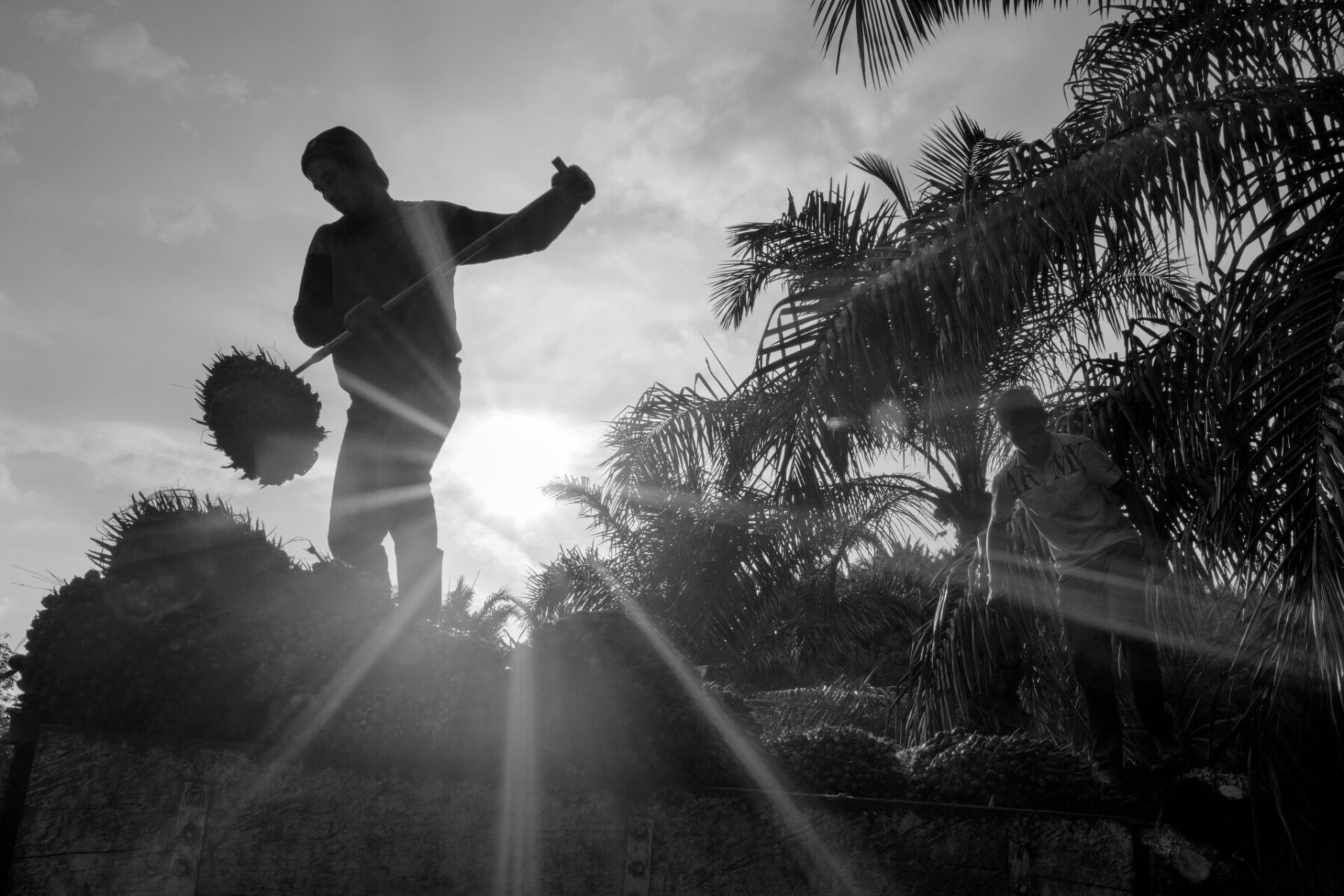
Indonesian migrant workers harvest fruits on a palm oil plantation in the Malaysian state of Sabah. © Romi Perbawa, all rights reserved

Malaysia: The British Empire forcibly transported workers from China and India to Malaya. The resulting racism and regressive labor policies persist to this day.

In his 1971 book „War of the Running Dogs“, British novelist Noel Barber described the former British colony Malaya as „one of the most beautiful countries on earth“. He goes on to paint a picture of a peaceful haven where „men of many skins and creeds lived in harmony“ – complete with imperialist paternalism as he labels people as either „gentle“, „industrious“, or „listless“ based solely on their ethnicity.

While the image of Malaysia as a harmonious melting pot has long endured in political rhetoric and national branding, so too have colonial constructions of racial ideology: the fictions of the indolent Malay, the venal Chinese, and the aggressive Indian are legacies that have outlasted the Empire, as the social demographer Charles Hirschman notes in his paper „The Making of Race in Colonial Malaya“.

Workers from China and India were forcibly transported to Malaya

This ideology was first crafted in 19th century colonial capitalist Malaya, when Chinese and Indian workers were found labouring in tin mines, in plantations, on roads, on railways, following British failure to fully absorb Malays into the colonial economy as wage labourers. War demanded tin and rubber, both plentiful in Malaya, and so the colonial powers imported labour from China and India. Work was often fragmented across nationality, and further split by ethnic or caste differences.
Malaysia, migrant workers, colonialism

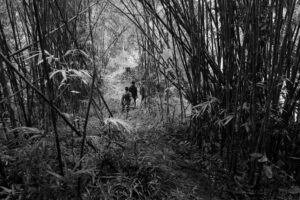
Indonesian migrants often attempt to enter Malaysia via illegal routes across the green border in Borneo/Kalimantan — as seen here from the Indonesian Entikong to the Malaysian Tebedu. © Romi Perbawa, all rights reserved

Coolies from China were brought to Malaya in batches, made to perform backbreaking labour, beaten, fed poorly, and denied freedom of movement. Indian labourers, too, were subject to the same suit of abuses: indentured labour, and harsh living and working conditions with worse punishments. These workers were made to work off the debt incurred by passage to Malaysia, although this would prove a Sisyphean task with a wage of just several cents a day. Worker action and protest was met with the most draconian of responses: sackings, deportations, cuts in food rations, and state violence; although over time workers groups slowly eked out better wages and conditions.

Colonial oppression as a blueprint for repressive labour laws

In 1957, the British granted Malaysia „independence“ by handing over power to members of the Malay elite who were sympathetic to the colonial rulers. However, the measures that Britain had taken to suppress workers and labour movements had long since become a blueprint for the exploitation of labour and a regressive approach to labour law – a hallmark of regions where European colonial powers had previously employed extractive strategies, as the American economist Daron Acemoglu notes in his article „The Colonial Origins of Comparative Development: An Empirical Investigation„.

Authoritarian control and the suppression of labour movements and unions were also hallmarks of colonial administration. The post-colonial continuity of these conditions is evident in today’s laws: following uprisings by forcibly displaced and immigrant workers, the British regime in the 1940s enacted ordinances that granted unlimited powers to ban unions. Union leaders deemed „communist sympathizers“ were executed.
Malaysia, migrant workers, colonialism

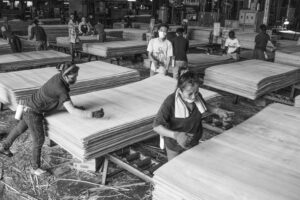
Plywood production in a factory of the Veracity Corporation in the Malaysian state of Sabah: Most workers come from Eastern Indonesia. © Romi Perbawa, all rights reserved

Up to this day, migrant workers are disallowed from forming new unions or becoming office-bearers in citizen-founded unions despite making up an estimated 2.2 million of the total 14.4 million employees in the labour force. Those found to be active in union movements are summarily dismissed and deported. Estimates of IndustriALL place the number of unionised migrant workers at a mere 10 per cent of the whole, with some forced to sign legally unenforceable agreements pledging not to join unions.

Migrant domestic workers are excluded from various protections in the Employment Act and therefore cannot legally unionise. This creates ripe conditions for precarity and abuse among documented and undocumented (mostly female) migrant workers, which some estimate could be as high as 5.5 million people. These workers hail from Bangladesh, Myanmar, Cambodia, India, Indonesia, Laos, Nepal, Pakistan, the Philippines, and Vietnam, among others.

Colonial racial ideology is still reflected in everyday prejudices today

Today’s migrant workers, upon whom Malaysia is so heavily reliant, undertake jobs classified as „3D“: dirty, difficult, and dangerous. These positions are unpopular among locals. However, by mistreating its foreign workforce, the country is perpetuating colonial-era practices, as political scientists Kamal Sadiq and Gerasimos Tsourapas argue in their study „Labour coercion and commodification: from the British Empire to postcolonial migration states“. They contend that Malaysia, as a postcolonial migration state, „reproduces colonial tropes through the surveillance and control of segmented migration flows that redistribute labor for the global economy“.
Malaysia, migrant workers, colonialism

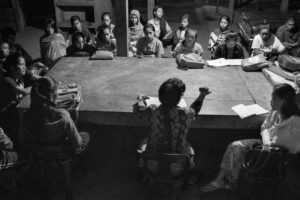
The children of Indonesian migrant workers in Keningau, Malaysia, receive lessons in a private home to avoid raids by the immigration police. © Romi Perbawa, all rights reserved

Similar to the absorbed racial ideologies of the colonizers, these workers endure commonplace and normalised xenophobia, both institutional and societal. During the Covid-19-pandemic, migrant workers were regularly rounded up, hosed down, and carted off to overcrowded detention centres. Migrant communities were placed under more stringent movement control measures and even had their residences cordoned off with barbed wire. Online, migrant workers are regularly ridiculed and mocked for being in public spaces during their days off. Media coverage of foreign workers involved in crime is often sensationalised despite only 0.1 per cent of foreigners being detained for crimes based on annual statistics.

Forced labour and modern-day slavery are a perennial and pressing issue, with workers earning a pittance and enduring poor living conditions. Categorised as Tier 2 in US State Department’s 2024 Trafficking in Persons Report, Malaysia has come under fire for practices indicative of forced labour: „violating contracts, wage fraud, assault, threats of deportation, the imposition of significant debts, and passport retention“ remain widespread.

Elites continue „coloniality without colonialism“
Malaysia, migrant workers, colonialism

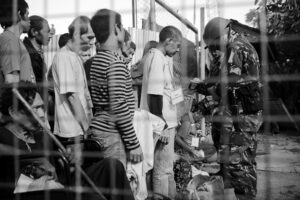
Illegal migrants from Indonesia are being deported from the Malaysian port of Tunon Taka Nunukan to their home country. © Romi Perbawa, all rights reserved

The parallels between present-day treatment of migrant workers and the British government’s capitalist colonialism in Malaya are a clear example of postcolonial continuity. With the perpetuation of race-based economic plans and policies that resulted in crony capitalism, elites have supplanted colonial masters to perpetuate the same „conditions of coloniality without colonialism“ as criticized by Malaysian author Syed Farid Alatas. Political scientist Christopher Choong emphasizes that it is about continuing the „postcolonial national repertoire“ of neoliberal success. Labour coercion and commodification were hallmarks of colonial capitalism, imperial legacies that are maintained both through legislative holdovers and institutional memory.

Old interviews with Chinese forced labourers who were deported to the region during the colonial era document how they were promised a good life upon recruitment. Reading today’s news reports about human trafficking, the parallels are clear: agencies lure workers from other countries with the promise of earning a substantial income that could lift them and their families out of poverty for generations.

In Malaysia, contemporary attitudes towards migrant labourers are, like colonial attitudes in the same regard, characterised by exploitation and control of what is seen as a cheap labour force necessary for economic development. The legacy of empire has extended into modern-day policymaking, enduring by taking on different shapes but resulting in the same consequences to marginalised bodies.

  • Articles


The author


Tashny Sukumaran is a research consultant and journalist with a particular focus on decent work, labour rights, and reducing social inequalities. Through her consistent human rights approach, she develops well-founded analyses and engages in effective advocacy. Currently, she is particularly interested in the topics of sustainability and climate protection.

    The User does not have any posts

  • Articles


The author


Romi Perbawa works as a freelance photographer specializing in long-term documentary projects. His photos have been published in outlets such as Stern, Time Magazine, The Guardian, and De Standaard. For his project „Au Loim Fain“ (translated: „I Want to Go Home“), he spent years documenting Indonesian migrant workers in Malaysia, Hong Kong, and Taiwan.

    The User does not have any posts

Creative Commons Lizenzvertrag
Dieser Text erscheint unter einer Creative Commons Namensnennung 4.0 International Lizenz


3 | 2024, English, Malaysia,
Autor*in:

Modern slavery in Malaysia

Malaysia: Historian Amrita Malhi explores how colonial influence and the legacy of resistance movements shape society and cultural discourse.

Malaysia’s cultures, religions and ethnic groups are strongly influenced by its colonial history and the search for a postcolonial identity. After gaining independence in 1957, the Malaysian state faced the challenge of reconciling the interests of its three largest ethnic groups: Malays, Chinese-Malaysians and Indian-Malaysians.

At the same time, it promoted a national identity based on Malay culture and the Islamic religion. Key measures were the emphasis on the Malay language as the national idiom and Islam as official religion (for Malays). This was further reinforced through political measures such as the New Economic Policy (NEP) in 1971, which aimed to improve the socio economic position of the Malays (bumiputera = “sons of the soil”)

There is no ONE postcolonial identity in Malaysia. Each ethnic group fosters its own cultural and religious practices. This results in a multicultural, but sometimes fragmented national identity. Amritha Malhi discusses how historical narratives shape present-day debates about cultural identity, the revival of traditional practices, and the risks of nationalist interpretations of history. Dr. Malhi’s insights bridge Malaysia’s colonial past and its complex present, offering a critical perspective on the challenges and possibilities of a truly inclusive postcolonial identity.

südostasien: How do you understand postcolonial identity and cultural heritage in Malaysia?

Amrita Malhi: Since UMNO [“United Malays National Organisation”, former ruling party, editor’s note] was ousted from the centre of Malaysian politics in 2018, a lively debate has emerged about postcolonial identity and cultural heritage. Before, UMNO’s dominance heavily shaped these discussions. Now, new, sometimes polarizing views are filling the void.

Some historians argue that non-Malay or non-Muslim influences in Malaysia are legacies of British colonialism and must be suppressed to achieve true decolonisation. Others argue that Malaysian society should embrace interdependencies between Malay-Muslim culture and other influences.

This debate reflects broader global challenges, such as climate change, geopolitical conflicts, and Covid-19’s socio-economic impacts. These issues demand collaboration across Malaysia’s diverse cultural and historical landscapes.

How would you describe your own cultural identity?

I was born in Malaysia and have lived in Australia since I was a child. In the late 1990s I chose to study South and Southeast Asian Studies. I completed an Asian Studies degree alongside a Bachelor of Arts and a PhD in Asian History.

Living between two cultures has influenced my perspective. The „Asian Studies“ field in Australia during the late 1990s, dominated by a white, enthusiastic narrative, felt alien to me. My perspective has always been shaped by viewing Asia from within, and the intertwining of Asian and Australian identity.

I engage critically with both Orientalism and cultural nationalism, which tend to oversimplify postcolonial discourse, especially in the diasporic context. While some decolonial approaches focus on nostalgia and cultural nationalism, they can also serve populist agendas. My work aims to recognize Asia’s complexities without romanticizing its past, and seeks to provide a more nuanced understanding of postcolonial issues.

What role do colonial influences play in your perception of cultural identity?

People like me exist because colonial and neocolonial powers reshaped the region. These influences are internalized; they’ve shaped who we are today. Postcolonial identity isn’t about rejecting the past but recognizing how deeply colonial histories continue to shape our present realities.

Inequality and global injustice are deeply rooted in colonial structures. Therefore, it is crucial to understand these historical influences for building a more equitable future. We can’t simply purge these influences; we must come to terms with how they continue to affect our identity and society, in order to shape a new future together.

How have colonial influences affected Malaysian society and its cultural identity?

Colonialism introduced the concept of „race,“ a notion that continues to dominate Malaysian public life. Racial categories were used to divide people and shape societal roles, behaviours, and expectations. These constructs have remained in place and continue to influence how Malaysians relate to one another.

While many Malaysians embrace the nation’s diversity and reject rigid racial divides, others perpetuate colonial racial ideologies, disguised as „decolonization“. Films like Mat Kilau promote the idea that anti-colonial resistance was solely the domain of Malay Muslims, ignoring the contributions of other communities. This narrative reproduces colonial-era divisions, showing how difficult it is to dismantle British race theory without reproducing it in new forms.

What traditional practices or rituals have been revived or reinterpreted in the postcolonial era?

Films like Mat Kilau, Malaysia’s highest-grossing film, have sparked cultural revivals, such as the wearing of the tanjak (headgear). While this practice isn’t inherently chauvinistic, it has become increasingly associated with nationalist agendas.

The revival of these cultural practices, often tied to anti-colonial sentiment, can both strengthen cultural identity or contribute to exclusionary ideas of who belongs to Malaysia. This is evident in the selective depiction of historical figures and events by certain nationalist narratives to support their agenda. The challenge is to critically engage with these movements to ensure that they don’t marginalize other cultural contributions.

My work on the uprisings in Terengganu and Pahang illustrates how temporary coalitions formed to drive them, challenging simplistic nationalist interpretations. These uprisings were complicated interactions between many varied interest groups, and drew on many sources. Their stories are often misrepresented in nationalist narratives.

How do you see the future development of Malaysia’s cultural identity in the context of global and postcolonial challenges?

Malaysia faces many critical questions about its cultural identity, especially in light of Asia’s rise and the increasing geopolitical tensions in the region. A key question that arises is: What is the value of deconstructing colonial knowledge? And perhaps more importantly, what should replace it?

At what point does Malaysia move beyond these colonial frameworks and constructs, allowing for a more inclusive and progressive identity to emerge? The country can only develop a fair cultural identity through inclusive approaches.

Interview by Charlotte Mei Yee Chin


Creative Commons Lizenzvertrag
Dieser Text erscheint unter einer Creative Commons Namensnennung 4.0 International Lizenz


3 | 2024, English, Malaysia,
Autor*in:

Modern slavery in Malaysia

Timor-Leste: Natalino Ornai Guterres talks about recent resistance against the growing LGBTIQA+ rights movement, centered on “proper” masculinity.

südostasien: How did your own journey lead you into LGBTIQA+ activism in Timor-Leste?

Natalino Ornai Guterres: I grew up in the capital Dili during the 1990s, when the country was still under Indonesian occupation [1975 – 1999]. After independence, the legacies of those 24 years stayed with us. Violence against children and young people was normalized in families, in schools, in the streets. Some of us started a small youth group to create safe spaces for children through art and dialogue. We even had a TV program on children’s rights and violence, linking it to patriarchy and power.

“I had grown up with a patriarchal image of God that was shaped by colonial influences.“

Even then, I felt different but couldn’t name it. There were not enough queer role models, and talking about gender or sexuality was taboo. When I appeared on TV and was read as “too feminine,” bullying got worse. Later, while studying abroad, I met people who lived openly. Therapy and rethinking faith helped me accept myself. I had grown up with a patriarchal God brought by colonizers, now I learned to see God as loving and forgiving.

Returning home in 2016, I was afraid of having to go back into the closet. But I also felt the queer community in Timor needed me. Together with friends, I co-founded Hatutan, a youth group for inclusion. We began by talking about equality and rights, then more openly about LGBTIQA+ issues. CODIVA, Timor-Leste’s umbrella network for LGBTIQA+ organizations, already existed, but we wanted to bring visibility to dignity and belonging. Together we started the Pride march. We called it a “March for Diversity” at first to test the waters. As Pride grew, so did understanding.

I was really struck by how fast Pride grew. How were you able to build such broad connection and support?

When we organized the first march in June 2017, I had the same feeling as in 1999 before the referendum: a sense of hope mixed with fear. We reached out to then Prime Minister Rui de Araujo for a statement of support and emphasized that independence must mean freedom for everyone.

For us, Pride was never an imported concept. It was about completing our struggle; fighting for acceptance and equality through solidarity, dialogue and policy instead of guns.

“For us, Pride was never an imported concept from the West.”

We featured voices like Mana Bella Galhos, a former youth independence activist and member of the LGBTIQA+ community, to highlight continuity between struggles for liberation, dignity, and human rights.

Of course, some people rejected this connection, arguing that the queer struggle is not a “national” one. If you only understand liberation through militarized masculinity, through uniforms and guns, then queer liberation, especially the aspect of queer joy and celebration, seems incomprehensible. But the resistance had many fronts: fighters, diplomats, civilians, women, youth. Pride simply asked for that diversity to be recognized.

For example, when I saw the journalist Max Stahl on news documenting the 1991 Santa Cruz massacre, he was one of the first ‘heroes’ without a gun. As he captured the massacre, where countless youth died as they were holding a peaceful protest, I realized I could make a contribution to my country, even if I didn’t carry a gun.

How do you see the legacy of resistance movement shaping ideas about gender and identity now?

The concept of heroism in Timor is still very masculine. The armed wing of the resistance struggle built a moral code around bravery, sacrifice, and control. The Catholic Church and legacies of colonialism reinforced it and showed men as heads of households, women as caregivers.

Even when we talk about gender equality, many men feel their identity is under threat. During Pride 2021, a TikTok video mocked our march, trying to belittle us by comparing us to youth in 1991 who “fought against guns.” We responded that both generations are brave, one fought for independence, the other for acceptance. We also highlighted Pepito’s story, who was openly mocked through this video. He was an integral part of founding Pride. His parents were also well-known resistance leaders. His father was disappeared in 1999 and his mother died shortly after independence. They gave their lives for their country’s freedom, so how can it be, that their own child can’t live freely and peacefully in that very same country?

This example also shows that while there was growing support, there was also contestation. Unfortunately, this culminated in a severe backlash in 2024. What happened, and what did it reveal?

It began when Mana Bella married in Darwin and the President José Ramos-Horta attended as a witness. What should have been a private celebration quickly turned into a political battlefield. At the time, Timor-Leste’s politics were already polarized: resistance leaders competed over moral and historical authority, accusing one another of having “fought less.”

When the President’s attendance at the wedding became public, opponents seized the moment. Drawing on homophobic narratives, they accused him of “destroying the moral fabric of the nation.”

Then, during the march, a feminist poster reading “A vagina is not a reproductive machine” – a message about dignity and choice – was twisted online into an attack on motherhood. The distortion spread fast, merging misogyny and homophobia under “family values.” Photos of trans-rights activists at the Presidential Palace went viral, mocked as desecrating a monument to national sacrifice. The outrage showed how nationalism and masculinity remain tightly linked, and how queer and trans bodies still threaten that moral order.

The irony was that Pride had often ended at the Palace with the same route, posters, and messages. Nothing had changed except how people chose to see them.

That’s why I believe the backlash was never just about homophobia. It was deeply tied to political rivalries and populist agendas that instrumentalized our lives and well-being for power, regardless of the social divisions they caused.

How did that shape how you organized Pride in 2025?

After what happened, we had to rethink what Pride should be. Some wanted to go louder, but most felt we needed care and safety first. Visibility without protection can be dangerous. We decided to focus on community rather than scale.

We changed the route from Metiaut to Cristo Rei, shorter and calmer. Some said we were hiding; we weren’t. We were healing. Without politicians or media spectacle, it felt like Pride belonged to us again.

“Sometimes progress means going slower, but together.”

For me, keeping Pride smaller was an act of resilience and resistance. It reminded us that our strength doesn’t come from visibility alone, but from the relationships and care that keep us going when things get hard. Sometimes moving forward means walking slowly, but together.

Those sound like powerful lessons, that we can also learn from globally. As anti-gender rhetoric and funding cuts have intensified over the past years globally, how are these shifts felt in Timor-Leste?

They hit hard. When USAID cut gender funding, CODIVA and others lost crucial resources. There’s a misconception that donors spend huge amounts on gender or queer issues, but in reality, it’s almost nothing. Still, funding matters because human rights work requires livelihoods, not just passion.

Some – even within our own community – say we should “go back to grassroots work,” but we never left it. Our work has always been community-based, we never relied on large donor projects. What we need now are sustainable partnerships: support for institutional development, social enterprise models, or long-term mentoring.

At the same time, the political climate is shifting. The current government is more populist, the Church remains powerful. The Secretary of State for Equality is an ally, but most leaders avoid the topic. Online, conservative influencers gain popularity by spreading hate. It’s frustrating and scary to see young people drawn into that.

A country can be independent and still not free if some live in fear. Democracy isn’t only about elections, it’s about how we treat difference, how we make space for everyone to live with dignity.

Queer rights test the depth of democracy. If we only defend freedom for those who look or love like us, then independence remains unfinished. Therefore Pride is about completing that struggle: to make freedom real for all.

In the face of the challenges you experience on a national and global level, what advice would you offer to other LGBTIQA+ activists and movements?

First, don’t let visibility become the only goal. Visibility without safety is exposure. Care and protection are also acts of resistance.

Second, build sustainability. Donor fatigue is real, but community fatigue is worse. We need to train leaders, diversify funding, and plan for longevity. Unfortunately, we also need to invest in our safety, both online and offline.

Third, build alliances that go beyond identity. Connect queer rights with broader human rights, democracy, and dignity. That’s how we linked Pride to independence: not as a special issue, but as part of everyone’s liberation. Similarly, democracy is not only about elections. It’s about how we treat difference, how we make space for everyone to live with dignity. For me, that’s what Pride means.

Finally, stay hopeful. When I see young queer Timorese marching and dancing, even after backlash, I remember 1999: the courage to dream of freedom.

Learn more about Pride in Timor-Leste via:

Timor-Leste Pride | Dili Timor-Leste | Facebook

Instagram

Creative Commons Lizenzvertrag
Dieser Text erscheint unter einer Creative Commons Namensnennung 4.0 International Lizenz


3 | 2024, English, Malaysia,
Autor*in:

Modern slavery in Malaysia

Myanmar/Thailand: Members of the exiled activist community in Thailand reflect on how the Spring Revolution has changed the meaning of masculinity.

“In my community, men are expected to be leaders. It seems like they have more opportunities and privileges, but at the same time, they’re also taught to be ready to sacrifice themselves for their family.” explains Nyein, a former teacher from the Sagaing Region when asked about traditional gender norms. Strong leader, powerholder, head of the household and the breadwinner: these are the most common markers of traditional masculinity in Myanmar.

Many of these are rooted in the concept of bhone, that ascribes higher power and status to men just by virtue of being born male: “When it comes to decision-making and leadership roles, those were always seen as positions meant only for men. This kind of mindset has been passed down and reinforced through generations. We were taught that men are somehow closer to God – that leadership and power belong to them. Women and others were never seen as having that same connection or authority.” explains Nicolas Thant, a non-binary art activist.

Challenges to traditional beliefs

Being in exile at the Thai border, some of these roles have changed due to the precarious situation people often find themselves in. Nan Hseng (name changed for security) who works for a local NGO in Mae Sot explains how she is now the main income earner: “As a woman from Myanmar, I still felt hesitant to call myself the breadwinner. It’s deeply rooted in our beliefs. It can be very difficult for men to accept that they’re not the ones providing for the family. It makes the men feel small. Even though my husband never said it outright, his actions and the way he spoke showed that he wasn’t comfortable. So I tried not to let others know.”

Women seem to be able to find jobs easier than men, doing service jobs, cleaning, teaching or factory work in Mae Sot. Some men step in and take over the household chores and care work which traditionally – and for many before going into exile exclusively – was done by their wives, girlfriends or daughters.

The impacts on men

For some men, the loss of income and status is challenging, as it goes against deeply held beliefs about masculinity and their sense of self-worth. Pandora, an activist and former PDF (People’s Defence Force, armed opposition to the military) fighter shared that she has witnessed the psychological and harmful effects this can have: “Sometimes, men become depressed when they are unemployed. In Myanmar, when they had a good job, life was more stable. But in Mae Sot, their lives have changed. They struggle to control their emotions when jobless, because society expects them to support their family financially, and take on leadership roles.”

In contrast, some men have embraced emotional openness and expression and are sharing their fears and worries more openly than before the revolution. They are more comfortable with crying in front of others, something that Pandora attributes to the changes of gender roles and expectations coming from the revolution.

Progressive online spaces vs realities on the ground

Views on whether the revolution has changed ideas about gender roles and masculinity seem divided. For some, there is a clear progress towards more gender equality. Feminist ideas are being shared and debated especially in online spaces, which is clearly regarded by many as a positive development. Pandora is one of them: “During this revolution, I had the opportunity to learn more about gender justice. I got to interact with different communities, including LGBTIQ+ and non-binary individuals, and I could speak with them directly. I learned to understand and accept much more than I did before the coup.”

Many non-governmental organizations and feminist groups rely on online discussions and seminars for education and advocacy. The question is, however, how impactful are these approaches when many people can’t access the internet easily. As Han Htet explains: “In Sagaing and other conflict-affected areas, people can’t stay online for long. They don’t have access to updated news and are focused on day-to-day survival. Even if they do get online, I’m not sure the discussions on Facebook ever reach them.” He sees the progressiveness of online debates lacking the connection to developments on the ground: “Most of the young people I work with on the frontlines, fighting the junta, are on the other side, I’d say. It’s not that they’re unwilling to change their perspectives – they just feel that those kinds of discussions don’t actually help weaken the junta in real life.”

How many debates and actual change people are able and willing to contribute to, might also be limited by the challenging life situation they are experiencing. Ko Htet, activist and founder of the local organisation Mae Sot Eain, reflects that online discussions often don’t lead to more understanding of gender issues but can fuel division and conflict: “Today, because of political pressure and daily struggles, people are exhausted and find it difficult to engage deeply with important issues or topics. When a new issue arises, few take the time to listen to different perspectives from both sides. Instead, people tend to respond quickly and emotionally, often with anger. As a result, discussions rarely lead to real solutions. Most debates end halfway through online, only to spark another round of online conflict. The cycle continues without resolution.”

Militarized masculinities on the rise

In online and offline spaces, war and armed conflict have increased the equation of masculinity with the military. Nan Hseng explained: “Being a man in Myanmar has completely changed since the coup. The role has shifted – from being the breadwinner to becoming a soldier or a hero in the fight for the revolution. “

This is nothing new in Myanmar`s militarized past. Many important historical figures have been men, which was why the military often portrayed them as heroes. Militarized masculinities furthermore sustain oppressive structures and behaviour. “In areas affected by the conflict, you can really see how deeply these ideas are rooted. Many people carry guns, and having a gun gives them power” Pandora illustrates.

Han Htet acknowledges that attributes like bravery, assertiveness, and protectiveness are necessary to fight the junta, but he also sees the negative effects of militarized masculinity on civilians and local PDFs: “Especially in Sagaing the PDFs are engaging in activities similar to what the military does, including killing civilians. These actions are harmful. So, while such traits may be useful for fighting the enemy, they are not good in other contexts, especially for people who are not involved in the war.”

Gender equality as a pillar of democracy?

In the Gender Equality Position Paper of the National Unity Consultative Council (NUCC), the political consultative body of the National Unity Government, gender equality is said to be an integral part of human rights and one of the basic elements of democracy. This seems to reflect how for many people one aspect of the current revolution is the fight against gender oppression. Nicholas Thant explains: “The revolution is not only against the dictatorship. It’s also a revolution of ideology. We are fighting to challenge deeply rooted systems of (toxic) masculinity, patriarchy, and outdated ways of thinking. These structures have dominated society for so long, and this revolution seeks to include everyone in changing them.”

Ko Htet explained that “the challenge is that while people try to accept and promote gender equality, […] many only pretend to understand it due to social pressure. In reality, their actions often go against the principles of gender equality.” These views surface frequently during critical online debates in which feminist ideas are being discredited.

Some question whether this is a unified understanding about gender equality: “It’s contradictory now – it seems like even people from the revolutionary groups are defending the old power structures that once favored them.”, said Nyein. Han Htet confirms this view: “There are also some men in the pro-democracy movement who seem almost allergic to gender equality.”

Outlook – Myanmar masculinities

Myanmar masculinities are clearly in transition. New ideas take hold, while old ones are being filled with more meaning. On the positive side, gender equality remains a topic of discussion, opposing views however are also on the rise. Moreover, the hardship people are experiencing through life in conflict zones and exile, don’t leave much space for engagement with these topics. Nan Hseng is nevertheless optimistic: “I don’t think this change will stop. Even in just a few years, there have already been many positive changes in Myanmar. And if we ever get the chance to go back – even if it takes a long time – I believe we’ll see more progress.”

Creative Commons Lizenzvertrag
Dieser Text erscheint unter einer Creative Commons Namensnennung 4.0 International Lizenz